


Page 366 - Ship Construction.DJ Eyres 6Ed
P. 366
Ch32-H8070.fm  Page 355  Wednesday, October 18, 2006  7:06 AM
                                        Structural Fire Protection               355
                 above the original temperature when the material is subjected to the stan-
                 dard fire test within the following times.

                                           Class     Time
                                                    (min)
                                           B–15       15
                                           B–0        0
                      --- ใช้เพื่อการศึกษาเท่านั้น---
                  ‘C’ class divisions are constructed of approved incombustible materials but
                          งานห้องสมุด ศูนย์ฝกพาณิชย์นาวี
                 do not need to meet with any specified requirements relative to passage of
                 smoke and flame nor temperature rise.
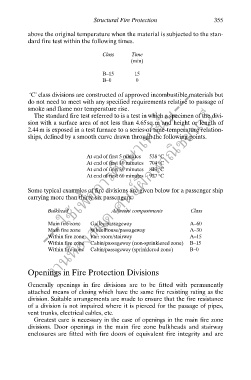
                   The standard fire test referred to is a test in which a specimen of the divi-
                 sion with a surface area of not less than 4.65sq.m and height or length of
                 2.44 m is exposed in a test furnace to a series of time-temperature relation-
                 ships, defined by a smooth curve drawn through the following points.


                                     At end of first 5 minutes  538 °C
                                     At end of first 10 minutes  704 °C
                                     At end of first 30 minutes  843 °C
                                                          ึ
                                     At end of first 60 minutes  927 °C
                 Some typical examples of fire divisions are given below for a passenger ship
                 carrying more than thirty-six passengers.

                        Bulkhead              Adjacent compartments      Class

                        Main fire zone  Galley/passageway                A–60
                        Main fire zone  Wheelhouse/passageway            A–30
                        Within fire zone  Fan room/stairway              A–15
                        Within fire zone  Cabin/passageway (non-sprinklered zone)  B–15
                        Within fire zone  Cabin/passageway (sprinklered zone)  B–0


                 Openings in Fire Protection Divisions

                 Generally openings in fire divisions are to be fitted with permanently
                 attached means of closing which have the same fire resisting rating as the
                 division. Suitable arrangements are made to ensure that the fire resistance
                 of a division is not impaired where it is pierced for the passage of pipes,
                 vent trunks, electrical cables, etc.
                   Greatest care is necessary in the case of openings in the main fire zone
                 divisions.  Door  openings  in  the  main fire zone bulkheads and stairway
                 enclosures are fitted with fire doors of equivalent fire integrity and are

