


Page 355 - Ship Construction.DJ Eyres 6Ed
P. 355
Ch31-H8070.fm  Page 344  Wednesday, October 18, 2006  7:06 AM
                 344                       Ship Construction
                 to sub-division requirements can result in the ship being able to load to
                 deeper drafts. This is particularly the case with bulk carriers since these
                 vessels can often be designed to obtain the ‘B-60’ freeboards; and where
                 this is impossible some reduction in freeboard may still be possible. The
                 Convention allows freeboards between that assigned to a Type ‘B’ and a
                 Type ‘B-60’ where it can be established that a one-compartment standard
                 of sub-division can be obtained at the draft of a Type ‘B’ vessel, but not at
                 B   --- ใช้เพื่อการศึกษาเท่านั้น---
                 the draft of a Type ‘B-60’.
                   Ore carriers of normal layout arranged with two longitudinal bulkheads
                 and having the side compartments as water ballast tanks, are particularly
                 suited to the assignment of Type ‘B-100’ freeboards, where the bulkhead
                 positions are carefully arranged. In the case of Type ‘A’, Type ‘B-100’, and
                 Type ‘B-60’ vessels over 225 m the machinery space is also to be treated as a
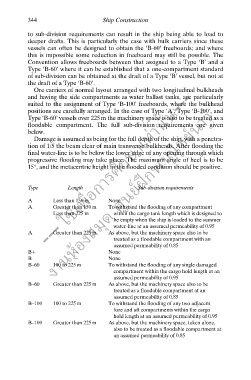
                 floodable compartment. The full sub-division requirements are given
                 below.
                   Damage is assumed as being for the full depth of the ship, with a penetra-
                 tion of 1/5 the beam clear of main transverse bulkheads. After flooding the
                 final water-line is to be below the lower edge of any opening through which
                 progressive flooding may take place. The maximum angle of heel is to be
                 15°, and the metacentric height in the flooded condition should be positive.
                                                          ึ


                 Type     งานห้องสมุด ศูนย์ฝกพาณิชย์นาวี
                               Length
                                                       Sub-division requirements
                 A        Less  than  150 m  None
                 A        Greater than 150 m   To withstand the flooding of any compartment
                          Less than 225 m      within the cargo tank length which is designed to
                                               be empty when the ship is loaded to the summer
                                               water-line at an assumed permeability of 0.95
                 A        Greater than 225 m  As above, but the machinery space also to be
                                               treated as a floodable compartment with an
                                               assumed permeability of 0.85
                 B+              —           None
                                 —           None
                 B–60     100 to 225 m       To withstand the flooding of any single damaged
                                               compartment within the cargo hold length at an
                                               assumed permeability of 0.95
                 B–60     Greater than 225 m  As above, but the machinery space also to be
                                               treated as a floodable compartment at an
                                               assumed permeability of 0.85
                 B–100    100 to 225 m       To withstand the flooding of any two adjacent
                                               fore and aft compartments within the cargo
                                               hold length at an assumed permeability of 0.95
                 B–100    Greater than 225 m  As above, but the machinery space, taken alone,
                                               also to be treated as a floodable compartment at
                                               an assumed permeability of 0.85

