


Page 323 - Ship Construction.DJ Eyres 6Ed
P. 323
Ch27-H8070.fm  Page 312  Wednesday, October 18, 2006  7:01 AM
                 312                       Ship Construction
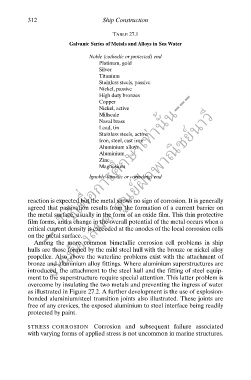
                                              TABLE 27.1
                               Galvanic Series of Metals and Alloys in Sea Water

                                      Noble (cathodic or protected) end
                                          Platinum, gold
                                          Silver
                                          Titanium
                      --- ใช้เพื่อการศึกษาเท่านั้น---
                                          Stainless steels, passive
                                          Nickel, passive
                                          High duty bronzes
                          งานห้องสมุด ศูนย์ฝกพาณิชย์นาวี
                                          Copper
                                          Nickel, active
                                          Millscale
                                          Naval brass
                                          Lead, tin
                                          Stainless steels, active
                                          Iron, steel, cast iron
                                          Aluminium alloys
                                          Aluminium
                                          Zinc
                                          Magnesium
                                                          ึ
                                      Ignoble (anodic or corroding) end


                 reaction is expected but the metal shows no sign of corrosion. It is generally
                 agreed that passivation results from the formation of a current barrier on
                 the metal surface, usually in the form of an oxide film. This thin protective
                 film forms, and a change in the overall potential of the metal occurs when a
                 critical current density is exceeded at the anodes of the local corrosion cells
                 on the metal surface.
                   Among the more common bimetallic corrosion cell problems in ship
                 hulls are those formed by the mild steel hull with the bronze or nickel alloy
                 propeller. Also above the waterline problems exist with the attachment of
                 bronze and aluminium alloy fittings. Where aluminium superstructures are
                 introduced, the attachment to the steel hull and the fitting of steel equip-
                 ment to the superstructure require special attention. This latter problem is
                 overcome by insulating the two metals and preventing the ingress of water
                 as illustrated in Figure 27.2. A further development is the use of explosion-
                 bonded aluminium/steel transition joints also illustrated. These joints are
                 free of any crevices, the exposed aluminium to steel interface being readily
                 protected by paint.

                 STRESS CORROSION Corrosion and subsequent failure associated
                 with varying forms of applied stress is not uncommon in marine structures.

