


Page 314 - Ship Construction.DJ Eyres 6Ed
P. 314
Ch26-H8070.fm  Page 303  Wednesday, October 18, 2006  7:01 AM
                                    Pumping and Piping Arrangements              303


                                   Closing
                                   valve
                                                                   Sluice
                                                   Mud             valve
                      --- ใช้เพื่อการศึกษาเท่านั้น---
                                                   box

                          งานห้องสมุด ศูนย์ฝกพาณิชย์นาวี
                                                                      Sea inlet box
                                              Anode                   Sea inlet grids
                                                                      positioned so that
                                                                      bars are in fore
                                                                      and aft direction


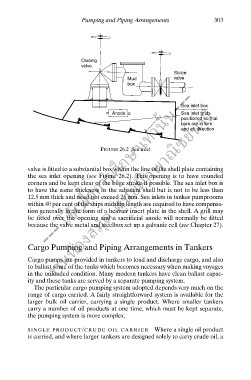
                                          FIGURE 26.2 Sea inlet


                 valve is fitted to a substantial box within the line of the shell plate containing
                                                          ึ
                 the sea inlet opening (see Figure 26.2). This opening is to have rounded
                 corners and be kept clear of the bilge strake if possible. The sea inlet box is
                 to have the same thickness as the adjacent shell but is not to be less than
                 12.5 mm thick and need not exceed 25 mm. Sea inlets in tanker pumprooms
                 within 40 per cent of the ships midship length are required to have compensa-
                 tion generally in the form of a heavier insert plate in the shell. A grill may
                 be fitted over the opening and a sacrificial anode will normally be fitted
                 because the valve metal and steelbox set up a galvanic cell (see Chapter 27).


                 Cargo Pumping and Piping Arrangements in Tankers

                 Cargo pumps are provided in tankers to load and discharge cargo, and also
                 to ballast some of the tanks which becomes necessary when making voyages
                 in the unloaded condition. Many modern tankers have clean ballast capac-
                 ity and these tanks are served by a separate pumping system.
                   The particular cargo pumping system adopted depends very much on the
                 range of cargo carried. A fairly straightforward system is available for the
                 larger bulk oil carrier, carrying a single product. Where smaller tankers
                 carry a number of oil products at one time, which must be kept separate,
                 the pumping system is more complex.

                 SINGLE PRODUCT/CRUDE OIL CARRIER Where a single oil product
                 is carried, and where larger tankers are designed solely to carry crude oil, a

