


Page 295 - Ship Construction.DJ Eyres 6Ed
P. 295
Ch24-H8070.fm  Page 284  Wednesday, October 18, 2006  7:00 AM
                 284                       Ship Construction
                   In determining the span loads and boom thrusts, not only is the derrick
                 safe working load considered to be  supported by the span, but also the
                 weight of the cargo purchase and half the boom weight. The other half of
                 the boom weight is supported by the gooseneck fitting.
                   Allowances must be made for the frictional resistance of the blocks when
                 determining the forces. This includes an allowance for the rope friction, i.e.
                 the effort required to bend and unbend the rope around the pulley, as well
                      --- ใช้เพื่อการศึกษาเท่านั้น---
                 as an allowance for journal friction. Shipbuilders using British Standards
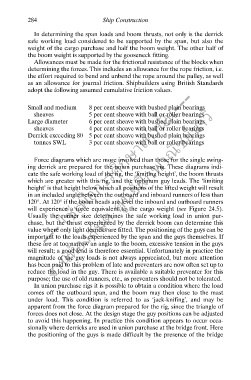
                 adopt the following assumed cumulative friction values.

                 Small and medium     8 per cent sheave with bushed plain bearings
                                      5 per cent sheave with ball or roller bearings
                   sheaves            4 per cent sheave with ball or roller bearingsาวี
                          งานห้องสมุด ศูนย์ฝกพาณิชย์น
                 Large diameter       6 per cent sheave with bushed plain bearings
                   sheaves
                 Derrick exceeding 80  5 per cent sheave with bushed plain bearings
                   tonnes SWL         3 per cent sheave with ball or roller bearings


                   Force diagrams which are more involved than those for the single swing-
                 ing derrick are prepared for the union purchase rig. These diagrams indi-
                                                          ึ
                 cate the safe working load of the rig, the ‘limiting height’, the boom thrusts
                 which are greater with this rig, and the optimum guy leads. The ‘limiting
                 height’ is that height below which all positions of the lifted weight will result
                 in an included angle between the outboard and inboard runners of less than
                 120°. At 120° if the boom heads are level the inboard and outboard runners
                 will experience a force equivalent to the cargo weight (see Figure 24.5).
                 Usually the runner size determines the safe working load in union pur-
                 chase, but the thrust experienced by the derrick boom can determine this
                 value where only light derricks are fitted. The positioning of the guys can be
                 important to the loads experienced by the span and the guys themselves. If
                 these are at too narrow an angle to the boom, excessive tension in the guys
                 will result; a good lead is therefore essential. Unfortunately in practice the
                 magnitude of the guy loads is not always appreciated, but more attention
                 has been paid to this problem of late and preventers are now often set up to
                 reduce the load in the guy. There is available a suitable preventer for this
                 purpose; the use of old runners, etc., as preventers should not be tolerated.
                   In union purchase rigs it is possible to obtain a condition where the load
                 comes off the outboard span, and the boom may then close to the mast
                 under load. This condition is referred to as ‘jack-knifing’, and may be
                 apparent from the force diagram prepared for the rig, since the triangle of
                 forces does not close. At the design stage the guy positions can be adjusted
                 to avoid this happening. In practice this condition appears to occur occa-
                 sionally where derricks are used in union purchase at the bridge front. Here
                 the positioning of the guys is made difficult by the presence of the bridge

