


Page 283 - Ship Construction.DJ Eyres 6Ed
P. 283
Ch23-H8070.fm  Page 272  Wednesday, October 18, 2006  7:38 AM
                 272                       Ship Construction
                 foam insulation. The system is fitted with a partial secondary barrier
                 consisting of a drip tray under the tank and splash shields at the sides. In
                 accordance with its Type B notation,  each tank is provided with sensors
                 which will detect leakage and allow timely repairs before any crack reaches
                 critical proportions.
                   Spherical tanks make poor use of available cargo space, a substantial hull
                 being required to house, say, 5 large spheres providing a cargo-carrying
                                    3
                      --- ใช้เพื่อการศึกษาเท่านั้น---
                 capacity of 125 000 m . Above deck the spheres are protected by substantial
                 weather covers.
                          งานห้องสมุด ศูนย์ฝกพาณิชย์นาวี
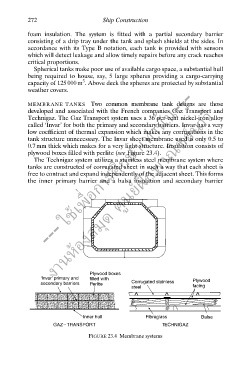
                 MEMBRANE TANKS Two common membrane tank designs are those
                 developed and associated with the French companies Gaz Transport and
                 Technigaz. The Gaz Transport system uses a 36 per cent nickel-iron alloy
                 called ‘Invar’ for both the primary and secondary barriers. Invar has a very
                 low coefficient of thermal expansion which makes any corrugations in the
                 tank structure unnecessary. The Invar sheet membrane used is only 0.5 to
                 0.7 mm thick which makes for a very light structure. Insulation consists of
                 plywood boxes filled with perlite (see Figure 23.4).
                   The Technigaz system utilizes a stainless steel membrane system where
                 tanks are constructed of corrugated sheet in such a way that each sheet is
                                                          ึ
                 free to contract and expand independently of the adjacent sheet. This forms
                 the inner primary barrier and a balsa insulation and secondary barrier


                                      Plywood boxes
                     ‘Invar’ primary and  filled with                     Plywood
                     secondary barriers  Perlite     Corrugated stainless
                                                     steel                facing


                                    Inner hull            Fibreglass         Balsa
                          GAZ–TRANSPORT                        TECHNIGAZ

                                      FIGURE 23.4 Membrane systems

