


Page 265 - Ship Construction.DJ Eyres 6Ed
P. 265
Ch22-H8070.fm  Page 254  Wednesday, October 18, 2006  6:59 AM
                 254                       Ship Construction
                                 Transverse
                                   web
                                                             ‘EH’
                      3 m                             ‘DH’           ‘DH’
                                                                                ‘EH’
                                                                   Inner hull
                                              Deck-transverse
                                                  web            Longitudinal
                                                                  bulkhead
                      --- ใช้เพื่อการศึกษาเท่านั้น---
                                               CENTRE
                                                TANK
                                                                 WING TANK
                          งานห้องสมุด ศูนย์ฝกพาณิชย์นาวี
                                              Length B.P  315 m
                                              Beam mld.  58 m    Intermediate
                                              Depth mld.  30.4 m
                          Stringer                                 stringer
                                            Plate
                                            bracket
                                                    Inner bottom
                 3.5 m                    Floor
                                          Floor
                                                                                 ‘EH’
                                                 ‘EH’  ‘DH’  ‘EH’    ‘DH’
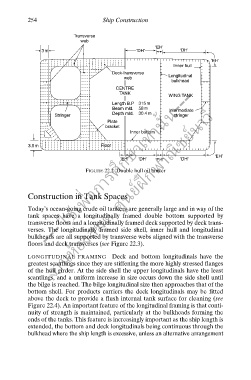
                                     FIGURE 22.2 Double hull oil tanker
                                                          ึ


                 Construction in Tank Spaces
                 Today’s ocean-going crude oil tankers are generally large and in way of the
                 tank spaces have a longitudinally framed double bottom supported by
                 transverse floors and a longitudinally framed deck supported by deck trans-
                 verses. The longitudinally framed side shell, inner hull and longitudinal
                 bulkheads are all supported by transverse webs aligned with the transverse
                 floors and deck transverses (see Figure 22.3).
                 LONGITUDINAL FRAMING Deck and bottom longitudinals have the
                 greatest scantlings since they are stiffening the more highly stressed flanges
                 of the hull girder. At the side shell the upper longitudinals have the least
                 scantlings, and a uniform increase in size occurs down the side shell until
                 the bilge is reached. The bilge longitudinal size then approaches that of the
                 bottom shell. For products carriers the deck longitudinals may be fitted
                 above the deck to provide a flush internal tank surface for cleaning (see
                 Figure 22.4). An important feature of the longitudinal framing is that conti-
                 nuity of strength is maintained, particularly at the bulkheads forming the
                 ends of the tanks. This feature is increasingly important as the ship length is
                 extended, the bottom and deck longitudinals being continuous through the
                 bulkhead where the ship length is excessive, unless an alternative arrangement

