


Page 203 - Ship Construction.DJ Eyres 6Ed
P. 203
Ch18-H8070.fm  Page 192  Wednesday, October 18, 2006  6:58 AM
                 192                       Ship Construction
                 be reduced to three, the aft peak bulkhead being at the aft end of the
                 machinery space.
                   Of these bulkheads perhaps the most important is the collision bulkhead
                 forward. It is a fact that the bow of at least one out of two ships involved in
                 a collision will be damaged. For this reason a heavy bulkhead is specified
                 and located so that it is not so far forward as to be damaged on impact.
                 Neither should it be too far aft so that the compartment flooded forward
                      --- ใช้เพื่อการศึกษาเท่านั้น---
                 causes excessive trim by the bow. Lloyd’s Register gives the location for
                 ships whose length does not exceed 200 m as not less than 5 and not greater
                 than 8 per cent of the ship’s length (Lloyd’s Length) from the fore end of
                          งานห้องสมุด ศูนย์ฝกพาณิชย์นาวี
                 the load waterline. As a rule this bulkhead is fitted at the minimum distance
                 in order to gain the maximum length for cargo stowage. The aft peak bulk-
                 head is intended to enclose the stern  tubes  in  a  watertight  compartment
                 preventing any emergency from leakage where the propeller shafts pierce
                 the hull. It is located well aft so that the peak when flooded would not cause
                 excessive trim by the stern. Machinery bulkheads provide a self-contained
                 compartment for engines and boilers preventing damage to these vital com-
                 ponents of the ship by flooding in an adjacent hold. They also localize any
                 fire originating in these spaces.
                   A minimum number of watertight bulkheads will only be found in smaller
                                                          ึ
                 cargo ships. As the size increases the classification society will recommend
                 additional bulkheads, partly to provide greater transverse strength, and also
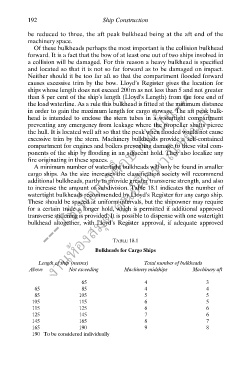
                 to increase the amount of subdivision. Table 18.1 indicates the number of
                 watertight bulkheads recommended by Lloyd’s Register for any cargo ship.
                 These should be spaced at uniform intervals, but the shipowner may require
                 for a certain  trade a longer hold, which is permitted if additional approved
                 transverse stiffening is provided. It is possible to dispense with one watertight
                 bulkhead altogether, with Lloyd’s Register approval, if adequate approved


                                              TABLE 18.1
                                        Bulkheads for Cargo Ships

                     Length of ship (metres)             Total number of bulkheads
                  Above        Not exceeding      Machinery midships      Machinery aft

                                    65                   4                    3
                   65               85                   4                    4
                   85              105                   5                    5
                  105              115                   6                    5
                  115              125                   6                    6
                  125              145                   7                    6
                  145              165                   8                    7
                  165              190                   9                    8
                  190 To be considered individually

