


Page 187 - Ship Construction.DJ Eyres 6Ed
P. 187
Ch17-H8070.fm  Page 176  Wednesday, October 18, 2006  6:57 AM
                 176                       Ship Construction
                                              TABLE 17.1

                             Requirement                     Structural member
                 1. Grade D where thickness less than   Sheerstrake or rounded gunwale over
                   15 mm otherwise Grade E.         40 per cent of length amidships in ships
                                                    exceeding 250 m in length.
                 2. Grade A where thickness less than   Sheerstrake and rounded gunwale
                      --- ใช้เพื่อการศึกษาเท่านั้น---
                   15 mm. Grade B where thickness 15 to   over 40 per cent of length amidships
                   20 mm. Grade D where thickness 20 to   in ships of 250 m or less in length.
                          งานห้องสมุด ศูนย์ฝกพาณิชย์นาวี
                   25 mm. Grade E where thickness greater  Bilge strake (other than for vessels
                   than 25 mm.                      of less than 150 m with double bottom
                                                    over full breadth).
                 3. Grade A where thickness less than   Bottom plating including keel. Bilge
                   20 mm. Grade B where thickness 20 to   strake (ships of less than 150 m and
                   25 mm. Grade D where thickness 25 to   with double bottom over full breadth).
                   40 mm. Grade E where thickness over
                   40 mm.
                 4. Grade A where thickness less than   Side plating.
                   30 mm. Grade B where thickness 30 to
                   40 mm. Grade D where thickness
                                                          ึ
                   greater than 40 mm.


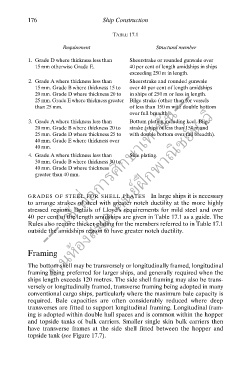
                 GRADES OF STEEL FOR SHELL PLATES In large ships it is necessary
                 to arrange strakes of steel with greater notch ductility at the more highly
                 stressed regions. Details of Lloyd’s requirements for mild steel and over
                 40 per cent of the length amidships are given in Table 17.1 as a guide. The
                 Rules also require thicker plating for the members referred to in Table 17.1
                 outside the amidships region to have greater notch ductility.


                 Framing
                 The bottom shell may be transversely or longitudinally framed, longitudinal
                 framing being preferred for larger ships, and generally required when the
                 ships length exceeds 120 metres. The side shell framing may also be trans-
                 versely or longitudinally framed, transverse framing being adopted in many
                 conventional cargo ships, particularly where the maximum bale capacity is
                 required. Bale capacities are often considerably reduced where deep
                 transverses are fitted to support longitudinal framing. Longitudinal fram-
                 ing is adopted within double hull spaces and is common within the hopper
                 and topside tanks of bulk carriers. Smaller single skin bulk carriers then
                 have transverse frames at the side shell fitted between the hopper and
                 topside tank (see Figure 17.7).

