


Page 186 - Ship Construction.DJ Eyres 6Ed
P. 186
Ch17-H8070.fm  Page 175  Wednesday, October 18, 2006  6:57 AM
                                       Shell Plating and Framing                 175
                                                                      25mm
                                                                      Rad notch
                                                                      cut in frame
                                                                      in way of seam

                                                             Welded butt
                                      Welded butt
                      --- ใช้เพื่อการศึกษาเท่านั้น---
                                                One frame             Frame
                          Welded seam           space
                          งานห้องสมุด ศูนย์ฝกพาณิชย์นาวี


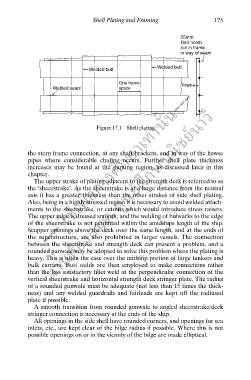
                                         Figure 17.1 Shell plating


                 the stern frame connection, at any shaft brackets, and in way of the hawse
                 pipes where considerable chafing occurs. Further shell plate thickness
                 increases may be found at the panting region, as discussed later in this
                 chapter.                                 ึ
                   The upper strake of plating adjacent to the strength deck is referred to as
                 the ‘sheerstrake’. As the sheerstrake is at a large distance from the neutral
                 axis it has a greater thickness than the other strakes of side shell plating.
                 Also, being in a highly stressed region it is necessary to avoid welded attach-
                 ments to the sheerstrake, or cutouts which would introduce stress raisers.
                 The upper edge is dressed smooth, and the welding of bulwarks to the edge
                 of the sheerstrake is not permitted within the amidships length of the ship.
                 Scupper openings above the deck over the same length, and at the ends of
                 the superstructure, are also prohibited in larger vessels. The connection
                 between the sheerstrake and strength deck can present a problem, and a
                 rounded gunwale may be adopted to solve this problem where the plating is
                 heavy. This is often the case over the midship portion of large tankers and
                 bulk carriers. Butt welds are then employed to make  connections  rather
                 than the less satisfactory fillet weld at the perpendicular connection of the
                 vertical sheerstrake and horizontal strength deck stringer plate. The radius
                 of a rounded gunwale must be adequate (not less than 15 times the thick-
                 ness) and any welded guardrails and fairleads are kept off the radiused
                 plate if possible.
                   A smooth transition from rounded gunwale to angled sheerstrake/deck
                 stringer connection is necessary at the ends of the ship.
                   All openings in the side shell have rounded corners, and openings for sea
                 inlets, etc., are kept clear of the bilge radius if possible. Where this is not
                 possible openings on or in the vicinity of the bilge are made elliptical.

