


Page 155 - Ship Construction.DJ Eyres 6Ed
P. 155
Ch14-H8070.fm  Page 144  Wednesday, October 18, 2006  6:56 AM
                 144                       Ship Construction
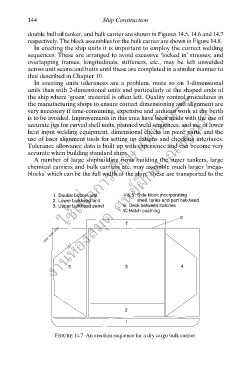
                 double hull oil tanker, and bulk carrier are shown in Figures 14.5, 14.6 and 14.7
                 respectively. The block assemblies for the bulk carrier are shown in Figure 14.8.
                   In erecting the ship units it is important to employ the correct welding
                 sequences. These are arranged to avoid excessive ‘locked in’ stresses; and
                 overlapping frames, longitudinals, stiffeners, etc., may be left unwelded
                 across unit seams and butts until these are completed in a similar manner to
                 that described in Chapter 10.
                          1. Double bottom unitการศึกษาเท่านั้น---
                   In erecting units tolerances are a problem, more so on 3-dimensional
                 units than with 2-dimensional units and particularly at the shaped ends of
                 the ship where ‘green’ material is often left. Quality control procedures in
                          งานห้องสมุด ศูนย์ฝกพาณิชย์นาวี
                 the manufacturing shops to ensure correct dimensioning and alignment are
                 very necessary if time-consuming, expensive and arduous work at the berth
                 is to be avoided. Improvements in this area have been made with the use of
                 accurate jigs for curved shell units, planned weld sequences, and use of lower
                 heat input welding equipment, dimensional checks on piece parts, and the
                 use of laser alignment tools for setting up datums and checking interfaces.
                 Tolerance allowance data is built up with experience and can become very
                 accurate when building standard ships.
                   A number of large shipbuilding firms building the super tankers, large
                 chemical carriers and bulk carriers etc. may assemble much larger ‘mega-
                                                          ึ
                 blocks’ which can be the full width of the ship. These are transported to the
                      --- ใช้เพื่อ                6. Deck between hatches  6

                                                  4 & 5. Side block incorporating
                                                       shell, tanks and part bulkhead
                          2. Lower bulkhead unit
                          3. Upper bulkhead panel
                                                  7. Hatch coaming
                                                   7


                               5                  3                   4


                                                  2

                                                  1

                          FIGURE 14.7 An erection sequence for a dry cargo bulk carrier

