


Page 104 - Ship Construction.DJ Eyres 6Ed
P. 104
Ch09-H8070.fm  Page 93  Wednesday, October 18, 2006  7:36 AM
                            Welding and Cutting Processes used in Shipbuilding    93
                                            Downward force

                                                          Movement
                                                          of tool
                                  Tool                          Rotation
                                                                of tool
                            Advancing side
                      --- ใช้เพื่อการศึกษาเท่านั้น---
                            of weld

                          งานห้องสมุด ศูนย์ฝกพาณิชย์นาวี
                                                                       Shoulder


                                                                Probe


                                                      Retreating side
                                                      of weld

                       Shoulder
                                                          ึ


                                 Height above                 Probe   Workpiece
                                 backing bar
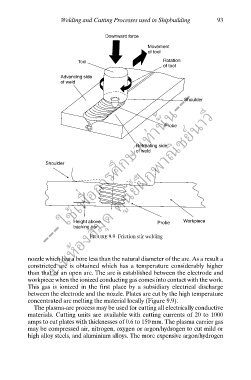
                                      FIGURE 9.9 Friction stir welding


                 nozzle which has a bore less than the natural diameter of the arc. As a result a
                 constricted arc is obtained which has a temperature considerably higher
                 than that of an open arc. The arc is established between the electrode and
                 workpiece when the ionized conducting gas comes into contact with the work.
                 This gas is ionized in the first place by a subsidiary electrical discharge
                 between the electrode and the nozzle. Plates are cut by the high temperature
                 concentrated arc melting the material locally (Figure 9.9).
                   The plasma-arc process may be used for cutting all electrically conductive
                 materials. Cutting units are available with cutting currents of 20 to 1000
                 amps to cut plates with thicknesses of 0.6 to 150 mm. The plasma carrier gas
                 may be compressed air, nitrogen, oxygen or argon/hydrogen to cut mild or
                 high alloy steels, and aluminium alloys. The more expensive argon/hydrogen

